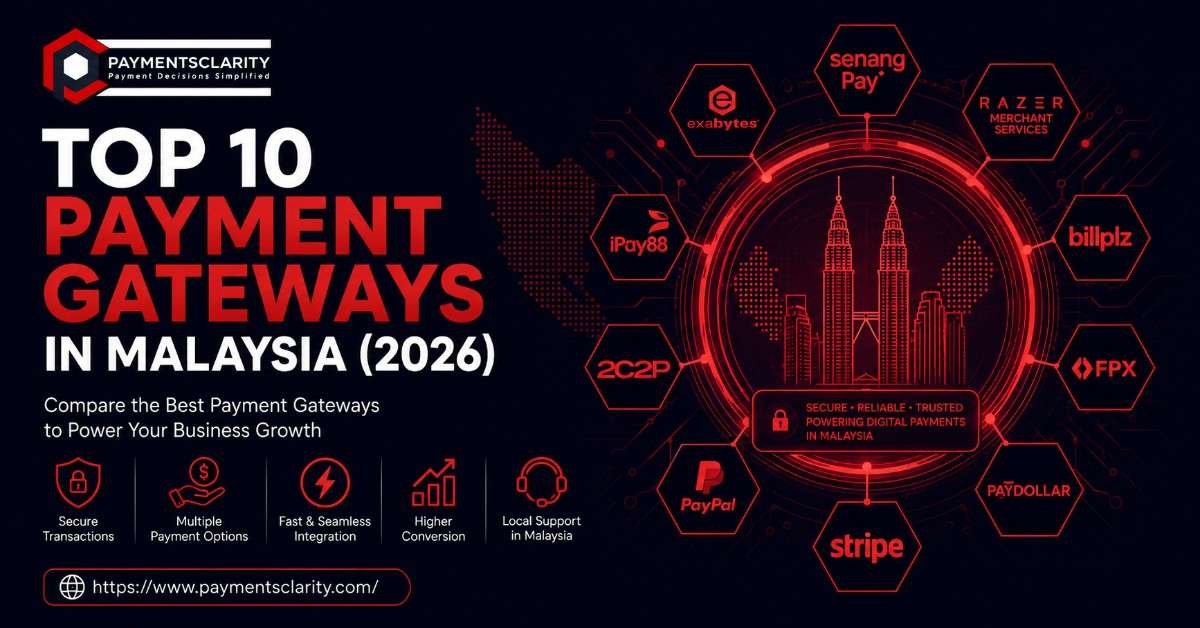
Top 10 Payment Gateways in Malaysia (2026)
Malaysia’s digital payments market is accelerating at a pace few industries match. According to Mordor Intelligence, the Malaysian payments market was valued at USD 262.5 billion in 2025 and is projected to reach USD 494.9 billion by 2031, registering an 11.15% compound annual growth rate (CAGR). Statista projects Malaysia’s digital commerce transaction value at USD 27.97 billion in 2025, growing to USD 54.83 billion by 2029.
Fuelling this growth: Bank Negara Malaysia’s (BNM) Financial Sector Blueprint 2022–2026 has made digital payments a national priority. According to BNM’s 2024 Annual Report, Malaysians made approximately 409 e-payments per capita in 2024 — up sharply from prior years. Retail e-payment transactions reached RM 698.1 billion in 2024, a 17% rise from RM 592 billion in 2023.
Choosing the wrong payment gateway in Malaysia directly costs you revenue. Whether you run an e-commerce store, a SaaS platform, or a high-risk business with global customers, the gateway sitting between your checkout and your customer’s bank determines conversion rates, settlement times, and total cost of processing.
This guide cuts through the noise with verified, source-backed data on the top 10 payment gateways in Malaysia, how they work, and which one deserves serious consideration for your business in 2026.
How Payment Gateways Work in Malaysia
A payment gateway is a secure digital intermediary that transmits payment data between the customer, the merchant, and the banking networks involved. When a buyer completes a checkout — whether on your website, mobile store, or physical counter — the gateway encrypts the transaction data, communicates with the relevant bank or payment network, and confirms whether the payment is approved or declined.
In Malaysia, the payment infrastructure has two unique pillars that any online payment gateway in Malaysia must support:
FPX (Financial Process Exchange): Operated by PayNet, a subsidiary of Bank Negara Malaysia, FPX is a real-time internet banking payment system that lets customers pay directly from their savings or current accounts. According to BNM’s own data, FPX consistently accounts for the highest share of e-commerce transaction volume in Malaysia — surpassing both credit and debit cards.
DuitNow: Also operated by PayNet, DuitNow is Malaysia’s interoperable QR payment standard. Customers scan one QR code using any participating bank app or e-wallet, with PayNet handling the back-end routing.
The full transaction flow — step by step:
- The buyer selects a payment method at checkout (card, FPX/DuitNow, e-wallet).
- The payment gateway encrypts the transaction data and may tokenise card numbers to reduce exposure.
- The encrypted data is sent to the acquiring bank, which forwards it to the card network (Visa, Mastercard) or to account-to-account rails such as DuitNow Online Banking/Wallets.
- The issuing bank verifies the customer’s balance and authentication.
- Approval or decline is returned through the same chain in seconds.
- The merchant receives settlement — timing varies from same-day (for some local gateways) to 5 business days (for international platforms).
Regulatory compliance matters: Any payment service provider operating in Malaysia must be licensed or registered with Bank Negara Malaysia. Providers handling fund transfers must hold a licence under the Money Services Business Act 2011, while merchant acquirers must be registered under the Financial Services Act 2013. Using an unlicensed provider exposes your business to regulatory risk.
Advantages of Having a Payment Gateway in Malaysia
Before diving into the Malaysia payment gateway comparison, here is why getting this infrastructure right pays off:
- Conversion rate protection. Malaysian consumers are highly accustomed to FPX, DuitNow QR, and local e-wallets. A checkout that does not offer these options loses sales at the final step. Digital wallets held a 34.92% share of Malaysia’s e-commerce payments in 2025, according to Mordor Intelligence.
- Security and fraud prevention. A PCI DSS-compliant gateway handles encryption, tokenisation, and 3D Secure authentication on your behalf — protecting you from chargebacks and data breaches.
- Multi-channel flexibility. Modern gateways support web checkouts, mobile apps, invoices, payment links, and POS systems from a single integration.
- Cross-border access. Malaysia’s e-commerce sector is estimated to surpass USD 20 billion by 2025 (Verified Market Research, 2025). A gateway that supports multi-currency settlement allows you to capture international orders without separate processors for each market.
- BNPL readiness. The buy-now-pay-later segment in Malaysia is the fastest-rising payment slice, projected to grow at a 17.18% CAGR to 2031 (Mordor Intelligence). Gateways that integrate Atome, Grab PayLater, and ShopBack PayLater keep you ahead of this shift.
- Compliance coverage. BNM’s Consumer Credit Act 2025 introduced new rules around BNPL affordability checks and delinquency reporting. Working with a compliant, licensed gateway reduces your regulatory exposure automatically.
Top 10 Payment Gateways in Malaysia
Below is a source-backed breakdown of the leading gateways used by Malaysian businesses in 2026 — including global names, regional platforms, and specialist providers.
1. Worldpay
Worldpay is one of the world’s most widely deployed payment processing platforms and is used by businesses across Malaysia seeking enterprise-grade global reach. According to Shopify’s published data, Worldpay’s e-commerce payment gateway operates in 150 countries and supports over 120 currencies, making it a practical option for Malaysian exporters and businesses with international customer bases.
Key features for Malaysian merchants:
- Omnichannel payment processing — covers online transactions and POS systems within the same infrastructure
- Advanced reporting tools and customisable payment flows
- Accepts all major credit/debit cards, digital wallets, and a wide range of local payment methods
- 24/7 customer support in multiple languages
- No refund charges
- Free setup fee
Considerations: Worldpay’s pricing is quote-based, and its subscription plan is denominated in GBP, which means the effective cost fluctuates with the MYR/GBP exchange rate. Its transaction fees are higher than dedicated local Malaysian gateways. Worldpay is best positioned for larger Malaysian businesses and enterprises that need a proven cross-border processing backbone rather than an SME-first domestic gateway.
2. iPay88
Founded in 2000, iPay88 is one of the most established names in Malaysia’s online payment gateway landscape. In 2025, iPay88 (then operating as Adaptis) was officially renamed to NTT DATA eCommerce Solutions Sdn. Bhd., strengthening its integration into NTT DATA’s global payment ecosystem and enhancing cross-border processing capabilities.
iPay88 is backed by over two decades of local bank connectivity and received the Best Payment Solution Award at the 2018 Mobile Business Excellence Awards (MBEA) and the Excellent Payment Solutions Provider Award at The 6th Lang International Corporate Titan Award 2024.
Supported payment methods: FPX, credit and debit cards (Visa, Mastercard, Amex), over 37 payment channels including GrabPay, ShopeePay, Alipay, PrestoPay, Apple Pay, and BNPL options.
Key features:
- Recurring billing and subscription management
- Cross-border payments with automatic currency switching — supporting Indonesia, Philippines, and China
- Advanced fraud detection and 3D Secure
- Supports direct link checkout, email payments
- No extra charges for refunds
Considerations: Higher setup fee compared to newer local gateways. SMEs do not benefit from annual fee waivers in the first year (though startups get zero annual fees). Transaction fees typically run 2–3%.
Best suited for established SMEs and enterprises requiring deep local bank integration and a long compliance track record.
3. Billplz
Billplz is a Malaysia-native online payment gateway built specifically for the local market. It is operated under PayNet’s FPX infrastructure and is particularly popular among SMEs, NGOs, and e-commerce operators for its transparent pricing and developer-friendly API.
Verified pricing:
- Basic Plan (free setup, no annual fee):
- Visa/Mastercard credit card: 1.8%
- Debit card: 1%
- Foreign credit card: 4.4%
- FPX online banking: RM 1.10 per transaction
- Standard Plan (RM 999 + 8% SST annually):
- FPX: RM 0.70 per transaction
- MaybankQRPay: 1% | ShopeePay: 1.1% | Touch ‘n Go / GrabPay: 1.2%
Key features:
- Supports FPX, credit/debit cards, e-wallets (GrabPay, Touch ‘n Go, ShopeePay, Boost), and BNPL (Grab PayLater at 6.5%, Atome at 6%)
- Webhooks, split payments, and API integrations with Shopify and WooCommerce
- Automated billing and subscription management
- Real-time reconciliation
- Only accepts MYR — no multi-currency support
- Registration open to SSM-registered Malaysian businesses only
Billplz’s FPX flat-rate pricing (RM 0.70 on the Standard Plan) makes it one of the cheapest payment gateway Malaysia options for businesses processing high FPX volumes. For businesses primarily serving Malaysian customers in MYR, Billplz offers a cost-efficient, compliance-ready foundation.
4. Payments Clarity
Payments Clarity (paymentsclarity.com) is a payment processing services provider specialising in high-risk merchant accounts, global credit card processing, and cross-border payment infrastructure. While many local Malaysian gateways decline applications from high-risk categories — including gaming, forex, crypto, nutraceuticals, travel, and subscription businesses — Payments Clarity is specifically built to serve these verticals.
Core services offered:
- Credit card processing (Visa, Mastercard, Amex) for standard and high-risk merchants
- Crypto payment processing, including on-ramp and off-ramp solutions
- Merchant bank account setup
- Open banking solutions
- Offshore company registration
- ACH payment processing
- Payment gateway provider services
Why it stands apart in Malaysia’s payment landscape: Most domestic gateways such as Billplz, iPay88, and Curlec are built around PayNet’s FPX/DuitNow infrastructure and serve primarily low-to-medium-risk businesses selling to Malaysian consumers. Payments Clarity fills a different gap — helping globally operating businesses, high-risk merchants, and companies needing multi-currency acquiring access payment infrastructure that most local providers cannot support.
For businesses in Malaysia that have been declined by standard gateway providers, or those running international operations requiring offshore merchant account setup alongside local processing, Payments Clarity offers a dedicated, compliance-aware advisory and setup service designed to prevent revenue loss from hidden fees and declined applications.
5. PayPal
PayPal has operated globally for over 20 years and remains a recognised brand in Malaysia, particularly valued by businesses selling to international customers. For Malaysia-based sellers, PayPal allows merchants to connect their store to a PayPal Business account, with withdrawals going to a local Malaysian bank account.
Verified fees for Malaysia:
- Standard domestic transaction rate: 3.90% + RM 2.00 per transaction — the highest standard rate among major gateways listed in this comparison
- Currency conversion markup: approximately 3–4%
Key features:
- Strong buyer protection and dispute resolution — builds trust with international shoppers
- Easy integration with major e-commerce platforms (Shopify, WooCommerce)
- Accepted in over 200 countries
- Plug-and-play setup
Considerations: PayPal does not support FPX, DuitNow QR, or Malaysian e-wallets such as Touch ‘n Go or GrabPay, making it a poor fit as a standalone gateway for businesses primarily serving domestic Malaysian customers. It is best used as a supplementary gateway for cross-border orders alongside a local primary gateway.
6. Curlec (by Razorpay)
Curlec was founded in 2018 in Kuala Lumpur and acquired by Razorpay India in 2022. In July 2023, Razorpay officially launched Curlec by Razorpay as a full-stack payment gateway in Malaysia — the first international payment gateway launched by an Indian fintech startup.
By 2025, Curlec’s merchant count grew to over 5,000 businesses, up from approximately 3,000 in October 2024. The company targets an annualised Gross Transaction Value (GTV) of RM 10 billion in Malaysia. Curlec reported 70% year-on-year volume growth and has received a licence to acquire merchants from Bank Negara Malaysia, with PayNet membership confirmed.
Clients include Tune Protect, CTOS, Courts, Mary Kay, and The National Kidney Foundation.
Key features:
- Full-stack gateway: FPX, DuitNow, cards, payment pages, payment links, and subscription/recurring billing
- Capacity for over 1,000 transactions per second, with 5× festive peak handling
- UPI payments launched in Malaysia in 2025 in partnership with NPCI International Payments Limited — enabling MYR settlement for Malaysian merchants accepting UPI
- Apple Pay support (rollout in 2025) — reported to improve cross-border conversion rates by up to 58%
- Powered by Razorpay’s technology, which already supports 10 million businesses in India
Curlec is the fastest-growing payment gateway in Malaysia by volume, making it a strong choice for SMEs and enterprises that want a technically robust, locally licensed, and rapidly evolving platform.
7. Rapyd
Rapyd is a global fintech infrastructure platform founded in 2015 by Arkady Karpman, Arik Shtilman, and Omer Priel. As of 2022, Rapyd is valued at USD 15 billion, making it one of Israel’s highest-valued unicorns. Rapyd is headquartered in London, UK, with offices across the globe.
Global reach: Rapyd allows businesses to accept payments from customers in over 100 countries and send payouts to over 190 countries, with access to 900+ local payment methods including cards, bank transfers, e-wallets, and cash.
Key features for Malaysia:
- Single API integration aggregates local payment methods globally — a key advantage for businesses operating across Southeast Asia, Latin America, and Africa simultaneously
- Accepts credit/debit cards and FPX in Malaysia
- Supports 103+ currencies
- Two-day onboarding and approval time
- Next-day settlement with fraud protection
Considerations: Rapyd is particularly strong for businesses that need to pay out as well as collect — making it practical for marketplace operators and platforms with cross-border supplier payments. Rapyd’s breadth means market-by-market checkout setup requires more planning than with a dedicated local gateway. Installment options are not universally available across all merchant categories in Malaysia.
Best suited for cross-border e-commerce operators and platforms that need consolidated global payment acceptance and disbursement infrastructure.
8. Stripe
Stripe is a global payment platform known for its developer-first API and strong international payment capabilities. It officially operates in Malaysia with support for local bank accounts and Malaysian business registration.
Verified fees for Malaysia:
- Standard rate: 3% + RM 1.00 per successful card or FPX transaction
- International cards: additional 1% surcharge
- Currency conversion: additional 2% fee
- Disputed payments (chargebacks): RM 90.00 fee; refunded if resolved in merchant’s favour
Key features:
- Advanced API for custom checkouts — preferred by developers and SaaS platforms
- Supports credit cards, digital wallets (Apple Pay, Google Pay), recurring billing, and subscription models
- 5-day rolling payout, with weekly or monthly options
- No setup fees or monthly fees (pay-per-transaction only)
- Strong documentation and plugin support
Considerations: Stripe’s standard rate in Malaysia (3% + RM 1.00) is notably higher than dedicated local gateways like Billplz (FPX at RM 0.70 flat). Critically, Stripe does not support DuitNow QR, which is an increasingly common payment method for Malaysian consumers. A checkout without DuitNow QR will see lower conversion among local buyers. Stripe also lacks the out-of-box local e-wallet integrations that iPay88 and Billplz provide natively.
Stripe is best positioned for SaaS companies and cross-border businesses that prioritise developer control, recurring billing, and international card acceptance over local e-wallet breadth.
9. dLocal
dLocal is a payment processing platform headquartered in Uruguay that specialises in enabling global merchants and brands to operate in emerging markets — including Malaysia and Southeast Asia, as well as Latin America and Africa. It provides infrastructure for both payment acceptance and payouts through a single unified API.
Key features:
- Accepts credit cards, digital wallets, bank transfers, and other local payment methods via one integrated platform
- Supports cross-border payments across multiple emerging markets simultaneously
- Merchant charges range between 2.7% and 7%, covering all-inclusive processing costs
- Payment processing time: 1–2 business days
- Customisable checkout pages
Best use case for Malaysia: dLocal is not a primary domestic Malaysian gateway — it does not have the deep FPX/DuitNow integration that local platforms offer. Its strength lies in enabling global enterprise merchants (typically in media, technology, and retail) to accept payments from Malaysian customers as part of a broader APAC or global expansion, without managing separate local providers in each country. For businesses that already use dLocal for Latin America and want to add Malaysia to their footprint, consolidation on one platform is the key value proposition.
10. Directa24
Directa24 is a payment solutions provider focused on Asia, Africa, India, and Latin America, offering single-API access to a wide range of international markets. It positions itself as a cross-border specialist for businesses looking to accept local payment methods in multiple regions without building separate integrations per country.
Key features:
- Single API integration providing access to local payment methods including cards, e-wallets, bank transfers, and cash
- Coverage spanning Asia-Pacific, Latin America, and Africa markets through one platform
- Secure transaction processing across all supported payment methods
- Supports merchants in complex multi-geography payment scenarios
Best use case for Malaysia: Like dLocal, Directa24 is primarily a global expansion tool rather than a domestic Malaysian payment gateway. It is relevant for businesses that need to deploy in Malaysia alongside other emerging markets through a single integration. Merchants looking for deep local Malaysian coverage — FPX, DuitNow, Touch ‘n Go, GrabPay — will be better served by a locally licensed gateway for their primary Malaysian transactions, with Directa24 supplementing cross-border needs.
Why You Should Choose Payments Clarity for a Payment Gateway in Malaysia
The Malaysian payment gateway market is well-served for standard e-commerce businesses. Platforms like Billplz, iPay88, and Curlec compete sharply on price and local payment coverage for merchants operating in low-to-medium-risk categories.
However, a significant segment of businesses operating in Malaysia faces a different challenge: high-risk merchant accounts, offshore business structures, international acquiring, and industries that standard Malaysian gateways decline by default.
This is precisely where Payments Clarity is built to deliver.
Payments Clarity is purpose-built for:
- High-risk industries — including gaming, forex, financial services, crypto, nutraceuticals, travel, and subscription businesses that face automatic declines or restrictive terms from standard local gateways
- Businesses needing crypto payment infrastructure — with both on-ramp (fiat to crypto) and off-ramp (crypto to fiat) solutions, including MYR settlement paths
- International merchant account setup — helping businesses structure their payment acquiring across multiple jurisdictions without losing access to Malaysian customers
- Offshore company registration with payment access — ensuring legal and processing infrastructure are aligned from the ground up
- Open banking solutions — enabling account-to-account payment flows beyond standard card and FPX channels
- ACH payment processing — for businesses with US-based customers or billing requirements
- Transparent fee structures — as the company itself states, its core promise is stopping merchants from losing revenue to hidden payment fees
What separates Payments Clarity from a standard gateway listing:
Most Malaysian payment gateways are acquirers — they process transactions directly. Payments Clarity operates as a payment infrastructure consultant and services provider, meaning they assess your business model, configure the optimal gateway and merchant account structure for your risk profile and geography, and handle the integration complexity that causes businesses to fall through the cracks of standard providers.
For a Malaysian business that has already been declined by iPay88, Billplz, or Stripe — or one that is scaling internationally and needs multi-currency acquiring alongside crypto processing — Payments Clarity removes the guesswork and the technical overhead that blocks revenue.
Conclusion: Getting Your Payment Gateway Decision Right in 2026
Malaysia’s payment gateway market has never offered more options — or more ways to choose the wrong one. The right gateway depends entirely on your business profile:
- Domestic SME selling in MYR? Billplz or Curlec offer the cheapest FPX rates and fastest local onboarding.
- Growing cross-border business? Stripe or Worldpay offer the developer tools and international card coverage you need.
- High-volume enterprise with local and international needs? iPay88 (NTT DATA) brings 25+ years of Malaysian bank relationships to the table.
- High-risk, crypto, or internationally structured business? Payments Clarity is the only provider on this list specifically designed for your situation.
The Malaysia payments market is projected to reach USD 494.9 billion by 2031 (Mordor Intelligence, Yahoo Finance, 2026). The businesses that capture the largest share of that growth will be the ones that built the right payment infrastructure before the market peaked — not after.
Get in touch with Payments Clarity to assess which payment gateway and merchant account structure is the right fit for your business in Malaysia.
General FAQs
Honestly, "cheapest" depends on how your customers actually pay. For FPX transactions — still the dominant online payment rail in Malaysia — Billplz charges a flat RM 0.70 per transaction on its Standard Plan, making it one of the lowest-cost options for local MYR businesses. Its Basic Plan comes with zero setup fee and no annual fee, though FPX goes up to RM 1.10 per transaction on that tier.
For credit cards, most local gateways sit between 1.8%–2.5%. International platforms cost more: Stripe charges 3% + RM 1.00 per transaction, while PayPal is the most expensive at 3.90% + RM 2.00 per transaction.
Here is where businesses often get caught out though — if your business is in a high-risk category, standard "cheap" gateways will simply decline you. Choosing the wrong provider in that situation means paying 5–8% per transaction, surrendering up to 10% of your revenue to a rolling reserve, and living under constant threat of your account being frozen. That is not cheap — that is expensive. Payments Clarity works directly with high-risk merchants to structure payment accounts that avoid exactly this trap, with transparent pricing and no hidden fees from day one.
Faster than you might expect with the right gateway slower than you need with the wrong one. Razorpay Curlec typically settles funds in T+2 (two business days), whereas some global providers may take up to 7 days. Stripe defaults to a 5-day rolling payout.
Settlement timelines vary by provider, acquirer, operational cut-off times, merchant risk tier, and industry category. F&B and retail businesses often prefer T+0 or T+1 for daily operational cash, while e-commerce sellers who restock frequently benefit from faster turnaround.
For high-risk businesses, the settlement picture gets murkier many processors impose rolling reserves, holding back 5–10% of your revenue for months. Payments Clarity operates as an ISO and specialised consulting partner, working alongside globally trusted PSPs and banking acquirers to secure merchant accounts with clear, compliant terms — which means faster, more predictable settlement rather than funds tied up in reserve accounts. Always ask any provider upfront: "What is your standard settlement time and do you hold a rolling reserve?
For most local Malaysian gateways, yes. You typically need your SSM business registration number, a copy of your MyKad or passport, and a Malaysian business bank account. Billplz, for example, only accepts SSM-registered Malaysian organisations personal bank accounts are not accepted.
International platforms like Stripe and PayPal have a slightly different onboarding process, but they still require a locally registered business bank account linked to your settlement currency country.
If your business is structured offshore, operates across multiple jurisdictions, or is in an industry that struggles to get approved regardless of registration status, that is where Payments Clarity comes in. They specialise in high-risk payment processing and offer dedicated merchant accounts for businesses in complex sectors, including offshore company registration as part of their service suite — so your legal structure and payment infrastructure are aligned from the start rather than colliding at the application stage.
Standard local gateways iPay88, Billplz, Curlec are built for low-to-medium-risk merchants in conventional industries. If you operate in gaming, forex, crypto, nutraceuticals, adult content, travel, IPTV, or subscription billing, you will face automatic rejection or heavily restricted terms from those platforms.
Payments Clarity is the direct answer to this question. They specialise in providing fast, secure, and efficient payment solutions tailored to high-risk businesses, covering online casino, IPTV, forex/crypto trading, iGaming, nutraceuticals, CBD, and adult industries — the exact verticals that mainstream Malaysian gateways decline. Their flagship services for high-risk businesses are the Open Banking and Credit Card Solution, and they are a fully certified credit card processor. LinkedIn
What makes them different from just "another gateway"? Payments Clarity is an ISO and specialised consulting partner — their responsibilities cover expertise, network access, and compliance support, the critical components needed to secure a merchant account in a high-risk industry. They do not give you a one-size-fits-all approval form. They assess your specific business model and connect you to the right acquiring bank for your risk profile and geography.
If your customers are Malaysian, there is a non-negotiable minimum. The minimum viable payment method set for a Malaysian merchant in 2026 includes DuitNow QR, FPX, Touch 'n Go eWallet, and GrabPay — a gateway missing these will lose conversions. Digital wallets led Malaysia's e-commerce payment share at 34.92% in 2025, while BNPL is the fastest-growing payment slice, projected to grow at 17.18% CAGR to 2031.
For businesses selling internationally from Malaysia or high-risk merchants needing global card acceptance alongside local methods — the requirements are broader still. You need multi-currency processing, international card network support, and potentially crypto payment options. Payments Clarity covers all of this: standard gateways, crypto processing, and high-risk solutions, with 24/7 technical support and systems integrated safely for businesses accepting international payments. Rather than stitching together three different providers for local FPX, international cards, and crypto, Payments Clarity helps you consolidate that infrastructure under one accountable partner — so your checkout covers every customer, wherever they are paying from.