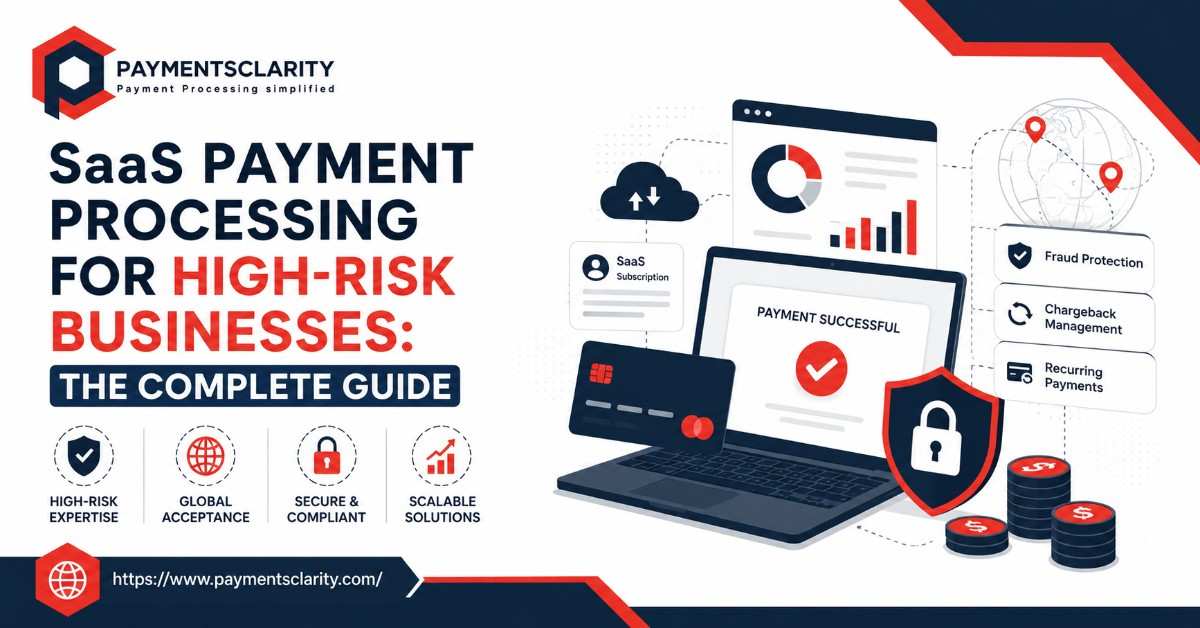
SaaS Payment Processing for High-Risk Businesses: The Complete Guide
Running a high-risk business comes with unique challenges — and payment processing is often the biggest one. Traditional banks frequently turn away merchants in high-risk industries, leaving founders scrambling for reliable, affordable solutions. That’s exactly where SaaS payment processing steps in.
In this guide, you’ll learn what makes SaaS the smartest payment infrastructure choice for high-risk businesses, the essential features to look for, and how to choose the right partner to support your growth.
What Is a High-Risk Business?
Financial institutions classify certain businesses as “high-risk” based on factors like elevated chargeback rates, regulatory scrutiny, fraud exposure, or the nature of the products and services sold. Industries that commonly fall under this label include:
- Nutraceuticals and dietary supplements
- Adult entertainment platforms
- CBD and cannabis-related businesses
- Travel agencies and booking services
- Online gaming and gambling
- Subscription box services
- Forex and cryptocurrency exchanges
Being labeled high-risk doesn’t mean your business is unviable — it simply means you need a payment processing solution built to handle your specific environment.
The Core Challenges High-Risk Merchants Face
Before exploring solutions, it’s worth understanding the obstacles that make payment processing so difficult in high-risk sectors:
- Limited Processor Access: Most mainstream payment processors and banks decline high-risk merchants outright, or impose strict volume caps and reserve requirements that can cripple cash flow.
- Higher Fees & Reserve Holds: When high-risk merchants do find a processor, they often face elevated transaction fees, rolling reserves, and unpredictable pricing structures that eat into margins.
- Chargeback Exposure: High-risk industries are disproportionately targeted by chargebacks. Without proper management tools, a spike in disputes can lead to account termination.
- Regulatory Complexity: Compliance requirements shift frequently across industries and regions. Staying current without dedicated support is time-consuming and risky.
Why SaaS Payment Processing Is the Right Solution
- SaaS (Software as a Service) payment processing: delivers a cloud-based, subscription-style model that gives high-risk merchants the flexibility, security, and advanced tooling that traditional processing simply can’t match.
- Here’s why it works:
- Scalability Without Infrastructure Costs: SaaS platforms are cloud-native, meaning you can scale your payment operations as your business grows — without investing in expensive hardware or on-premise software.
- Transparent, Predictable Pricing: Unlike legacy processors that bury fees in contracts, quality SaaS providers offer straightforward pricing with no hidden charges, making financial planning far easier.
- Built-In Security & Compliance: Reputable SaaS payment processors maintain PCI-DSS compliance, data encryption, and proactive fraud monitoring — taking the compliance burden off your plate.
- Advanced Automation: From recurring billing to chargeback alerts and subscription lifecycle management, SaaS platforms automate the operational tasks that would otherwise demand significant manual effort.
Essential Features to Look for in a SaaS Payment Processor
Not all SaaS payment processors are created equal — especially when it comes to high-risk support. Here are the non-negotiable features your solution should include:
- Multiple Payment Methods: Your customers have preferences. A robust SaaS payment processing platform should support credit cards, debit cards, eChecks, ACH transfers, and ideally cryptocurrency — giving every customer a path to purchase.
- Global Payment Capabilities: If you’re targeting international markets, your processor must handle multi-currency transactions, cross-border compliance, and localized payment methods without friction.
- Fraud Detection & Prevention: Look for real-time fraud screening, velocity checks, IP filtering, and 3D Secure authentication. For high-risk businesses, proactive fraud prevention isn’t optional — it’s essential.
- Chargeback Management Tools: A strong SaaS payment processor will offer automated chargeback alerts, dispute management workflows, and representation support to help you win disputes and protect your merchant account.
- Industry-Specific Compliance Support: Regulations vary by industry and jurisdiction. Your processor should understand your space and offer compliance guidance tailored to your business model.
Beyond Basics: Value-Added Services That Matter
The best SaaS payment processing partners don’t just move money — they help you run a smarter business. Look for these value-added services:
- Dedicated Merchant Accounts: For high-risk businesses, having a dedicated merchant account (rather than being aggregated with thousands of others) means greater stability, fewer holds, and a lower risk of sudden account terminations.
- Subscription & Recurring Billing Management: If your business runs on a subscription model, you need tools to handle plan upgrades, downgrades, failed payment retries, and cancellation flows — all within the same platform.
- Transaction Analytics & Reporting: Data-driven decisions require clean data. Look for a platform that provides real-time dashboards, trend analysis, and exportable reports to inform your strategy.
- 24/7 Dedicated Support: When payment issues arise — and they will — you need a support team that understands high-risk commerce and can resolve problems fast. Generic chat support won’t cut it.
SaaS vs. Traditional Payment Processing: A Direct Comparison
Feature | Traditional Processing | SaaS Payment Processing |
Flexibility | Limited, often hardware-dependent | Fully cloud-based, highly scalable |
Pricing | High upfront costs, hidden fees | Transparent, subscription-based pricing |
Security | Varies by provider | PCI-DSS compliant, enterprise-grade |
Payment Methods | Restricted options | Credit, debit, ACH, crypto & more |
Recurring Billing | Manual or add-on cost | Built-in automation |
Chargeback Management | Manual, reactive | Automated alerts & dispute tools |
Compliance Support | Minimal | Industry-specific guidance |
Customer Support | Limited hours, often outsourced | Dedicated, around-the-clock access |
How to Choose the Right SaaS Payment Processing Partner
With so many platforms on the market, narrowing down your options requires a clear evaluation framework. Ask these questions before committing:
- Does the processor have documented experience with your specific industry?
- Are all fees and reserve requirements disclosed upfront?
- What fraud and chargeback tools are included — and are they automated?
- Is the platform PCI-DSS Level 1 compliant?
- Can it handle your current volume and scale with you as you grow?
- What does customer support look like — dedicated account manager or a shared queue?
Take time to read third-party reviews, request a demo, and test the onboarding process before signing any contract.
Final Thoughts
For high-risk businesses, SaaS payment processing isn’t just a convenience — it’s a strategic necessity. The right platform gives you the security, flexibility, and automation to operate with confidence, reduce costly disruptions, and focus on what actually grows your business.
Don’t settle for a processor that treats you as a liability. Partner with a team that understands the high-risk landscape, offers transparent pricing, and has the tools to help you scale.
Ready to simplify your payment operations? Contact Payments Clarity today and discover what the right SaaS payment processing partner can do for your business.
General FAQs
SaaS payment processing is cloud-based, subscription-driven, and comes with advanced features like automated billing, real-time fraud tools, and chargeback management — all in one platform. Traditional processors typically require hardware, carry higher upfront costs, and offer fewer features out of the box.
Yes — with the right provider. Processors like Payments Clarity specialize in onboarding high-risk merchants across a wide range of industries and have experience navigating the approval process for businesses that mainstream providers decline.
Quality SaaS platforms offer automated chargeback alert systems, dispute management workflows, and dedicated support to help merchants respond to and win chargebacks before they escalate to account termination.
Absolutely. Reputable SaaS providers maintain PCI-DSS compliance, use tokenization and encryption, and implement real-time fraud screening to protect both your business and your customers.
Most platforms support credit and debit cards, ACH/eCheck, and bank transfers. More advanced providers — including Payments Clarity — also support cryptocurrency payments, making your service accessible to a broader audience.